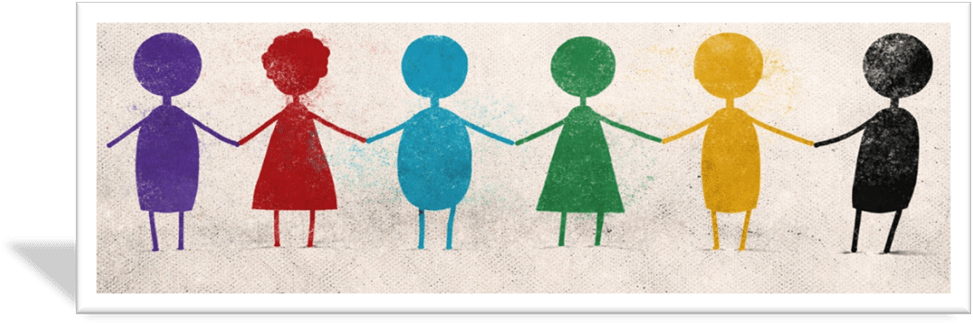
I like looking up words as they are used and defined. The dictionary describes marginal as “on the margins of (something)”—existing at the periphery of a larger group, receiving little or less attention compared to the majority. The margin is not outside the page; it is still part of it. In fact, you are considered close enough to observe, far enough to be overlooked.
It just carries less weight, less visibility, less expectation.
Marginality is sometimes synonymous with vulnerable. At other times, it is read as difference, strange, peculiar, misfitting. So, when you are marginalized, people tend to respond in predictable ways, they either try to save you, or they quietly observe and gaze.
If you are thinking, surely there’s more to this, you’re right, below are more meanings of marginalization,
Table: Meanings of Marginalization
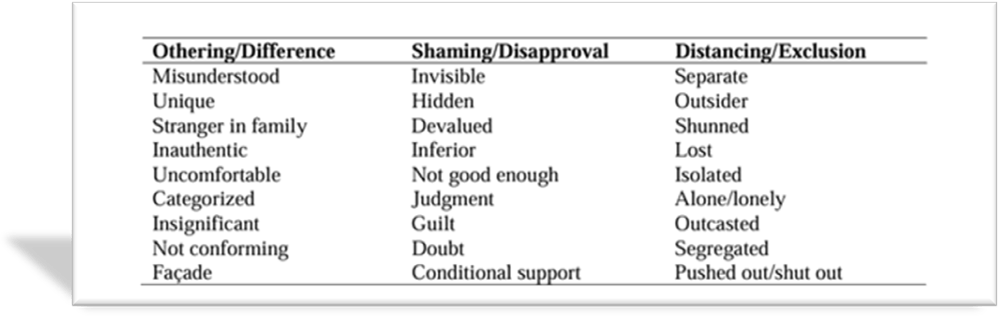
Adapted from The Process and Dimensions of Family Member Marginalization: A Mixed-Method Construct Explication, by E. D. Hall, 2015
I grew up in the marginal.
I was the “weaker” twin in terms of health and size, I was often sick, clumsy, and bullied (my twin and I at least shared that part, which offered a small sense of relief). I struggled with low self-esteem, was attention-seeking, and was not considered the smartest in the family. My grades were mostly mediocre, sometimes outright bad. My primary school and high school teachers are probably still trying to figure out how I got a doctorate. I am sure my childhood classmates are too.
My experience with marginality began early, long before I had the language to name it.
But marginality does not wear a single face. For some, it is about health or learning differences. For others, it is about poverty, race, gender, accent, migration status, religion, queerness, family reputation, or simply not fitting the expected narrative of who someone is supposed to be. Some people are marginalised loudly, through open exclusion. Others experience it quietly through lowered expectations, subtle comparisons, silences, and the constant sense of being slightly out of place. You are present, but not central. Included, but not anchored.
Research helped me later to recognise these patterns. A study by Elizabeth Dorrance Hall (2015) describes family member marginalisation as a complex and evolving process, shaped by comparison, unmet expectations, and relational standards. Unlike other social groups, families are assumed to be sites of unconditional belonging. When that belonging becomes conditional or uneven, the effects are deeply felt. Marginality within families often shifts over time, appearing and disappearing depending on context, behaviour, or life stage that someone inhabits but it leaves traces.
Drawing on Michael A. Hogg (2005), Hall explains that people who exist on the boundary between in-groups (those aligned with the values, expectations of the family in this case) and out-groups (those who don’t) experience heightened rejection. They tend to hold little influence and are compared more frequently or watched more closely. As a child, this in-between position showed up in subtle but persistent ways. I was not excluded; I was very much there! I attended family gatherings, shared spaces, felt love, belonged, and carried the family name. But I was not fully trusted to get things right. I was inside enough to be held accountable, but not inside enough to be to be given the benefit of the doubt.

In academic grades, I was compared to my siblings, and if you have an identical twin, comparison becomes relentless. Everything turns into a puzzle of how you are not identical in everything including intelligence, emotional regulation, and success (we are insanely physically identical, by the way. Sometimes I see her when I look in the mirror… stranger things!)
Difference feels like failure. I am certain I was the worst teenager my parents had to parent. Tantrum-filled, suicidal, problematic at school, rebellious, self-harmed, anything you can think of. My dad was always on me. Eventually, if something went wrong in a group of friends or cousins, I was the default suspect. There are countless examples, but those stories can wait.
And yet, I turned out well.
For a long time, I asked myself why. What I have come to understand is that at some point, I stopped resisting the margin and began to work with it. I took it, and I owned it. When you are positioned at the margins, people’s expectations are often minimal. Some try to save you. Others simply stop expecting anything at all. That lack of expectation can feel like abandonment, but it can also become a strange kind of freedom.
This is where bell hooks helped me reframe my experience. She writes about marginality not only as a site of deprivation, but as a site of resistance and possibility. For hooks, the margin is not just a place one is pushed into; it can also be a place one chooses to remain, because it allows for a different way of seeing. From the margin, you can observe the centre without being fully absorbed by it. You can critique it, question it, and imagine alternatives.
Living on the margins, hooks suggests, can cultivate a particular clarity. You learn how systems work because you are not protected by them. You learn how power moves because it moves around you. In this way, marginality becomes a space of insight rather than only injury.
That resonates deeply with my own story.
When people expect very little from you, failure does not shock them but success does. If you fail, it simply confirms what was already assumed. If you succeed, you disrupt the narrative. Slowly but surely, that is what I did. I stopped depending on others’ approval. The only expectations that mattered were my own. I let go of the need to please and focused instead on keeping it moving. Quietly. Imperfectly. Persistently.
To this day, my mantra remains: keep it moving. You don’t need an applause or validation!
Story time…. I want to give you a glimpse of what I mean, a snapshot from the many, sometimes hilarious, moments of my marginal existence.
What most people don’t know is that I repeated a level at school. One of my dear uncles still jokes about it decades later. Every time he sees me, he says, “Ndiwe wekufoira Form 4 ka iwe,” loosely translated as, “You’re the one who failed Form 4.”
I mean……I AM LEGEND!!!
Even now, he says it with disbelief, astonished by what I became. Honestly, I’m astonished too. As a Christian, I call it grace. Or a miracle. I still can’t quite decide. Both is where I love to settle.
During my A-levels, my mum once said, “Mwanangu akaita 2 points anenge apasa,” meaning, “If my daughter gets 2 points, that counts as a pass.” To understand how low that expectation was, you need a bit of context. In the Zimbabwean A-level education system, points are awarded per subject, and competitive university entry often requires well over 10 points. Two points is not excellence, it is barely surviving. Again LEGEND!
And yet, that expectation didn’t disappoint me. Instead, it freed me. I realised I didn’t have a bar hanging over my head. There was no crushing pressure to perform. I could get 2 points, or I could aim for more. Either way, I wasn’t carrying the burden of proving myself to anyone.
That absence of pressure mattered more than people realise.
Each small step forward felt significant, not because it was dramatic or celebrated, but because it was unexpected. I challenged myself without the weight of representing anything or anyone else. I was not trying to redeem a reputation or live up to a family narrative. The margin gave me space to grow without constant surveillance.
And in that quiet, underestimated space, I learned how to keep moving.
So, remember this: your place in the margins can be your greatest asset.
I share this story not as a resolution, but as a recognition. Marginality does not end neatly. It shifts, reappears, takes new forms. Many of us move in and out of the margins throughout our lives. Sometimes by force, sometimes by choice.
Being in the margins does not mean you are less important, less capable, or merely vulnerable. Sometimes it is exactly this position, this distance from the centre, that allows for growth, resilience, and a depth of understanding others may never have had to develop. The margin is not empty.
It is full of perspective.
Embrace the marginal!

 The Ambiguous Space
Leave a comment