Ambiguity, Ambivalence, and Marginality as Spaces for Resistance
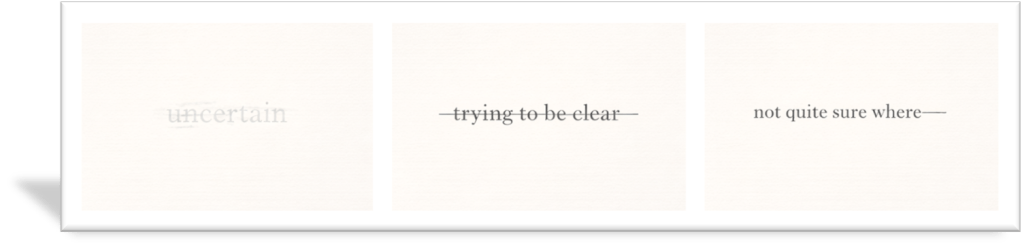
I have been reflecting on this question for a long time. It has followed me across different stages of my life, often resurfacing in moments of transition, uncertainty, or quiet resistance. My recent research did not offer me clarity in the conventional sense, but it did make me bolder. It helped me realize that ambiguity is not a bad space to sit in comfortably. In fact, it can be strategic. It can be intentional. As I have written in my yet to be published thesis, I embrace ambiguity as a set of productive tensions. This realization gave me permission to begin this website, not as a space of answers, but as a space for thinking.
Rather than presenting conclusions, I will share pieces of my research and other writings here over time, alongside reflections that sit somewhere between the personal and the theoretical. What interests me is not resolution, but exploration. I am drawn to moments where things remain unresolved, where language hesitates, and where identity refuses to settle into a single form.
One of the recurring questions I encounter, particularly because my research has a strong focus on women’s liberation, is whether I am feminist or not. The persistence of this question is revealing. It is not only about feminism, but about the demand to name oneself clearly and consistently. It raises broader questions about whether naming or refusing to name ourselves shapes how we engage in social justice, how we build alliances, and how we imagine change.
This is not a discussion about feminism as a position or an identity. I use it here only as an example. In other instances, even something as simple as whether I am a vegetarian or not has been placed on the table. What this space is truly concerned with is the act of naming and unnaming itself. As humans, we rely heavily on labels, categories, and binaries to orient ourselves in the world. These structures can offer belonging and clarity, but they can also constrain us. When we do not fit neatly into them, or when we resist them altogether, we often become suspect.
There is a particular discomfort directed at those who choose to remain in between. Ambiguity is rarely welcomed. Ambivalence is often read as indecision or weakness. Marginality is treated as a failure. When we refuse to choose a side, or when our position shifts over time, we are frequently pressured to explain ourselves or at least to commit to something- a box.
Each time I am asked which box I belong to, and I hesitate or change my answer, I walk away questioning myself. I wonder whether I chose the right side, whether I offended someone, or whether my refusal to be clear caused harm. I find myself asking whether I have slipped into marginality, and if so, whether that marginality is something to resist or something to embrace. I exist in between, and I sit comfortably there.

Marginality, however, has been tainted. It is often framed as a negative space, something to escape rather than inhabit. Yet it is not necessarily a bad place to be. As bell hooks defined it more positively, it is “a site of radical possibility, a space for resistance.” And so perhaps this in between space, rather than being a weakness, can be understood as a deliberate and progressive position.
These grey and unclear areas exist everywhere. They appear in expectations around behaviour and appearance, in how success is defined and measured, and in the narratives we inherit about careers, productivity, and adulthood. We are taught what a reasonably acceptable life is supposed to look like, and deviation from that script is quietly, and sometimes loudly, corrected or socially punished.
From an early age, we are encouraged to be uncomfortable with uncertainty. Ambiguity is framed as something to overcome rather than embrace. Ambivalence is treated as a problem to be solved. There is an urgency to resolve, to clarify, and to arrive at conclusions that can be easily communicated and justified.
Yet ambiguity and ambivalence can be meaningful places. They can slow us down. They can allow us to live in the moment, even when things remain unclear, rather than forcing defined binaries. Labels, in many ways, have come to matter more than living itself. We spend so much time learning how to describe who we are that we lose sight of the experience of becoming. The demand for acceptability and affirmation often overrides the complexity of our inner lives, which are, much of the time, ambiguous.
I am introducing a space to engage. The ambiguous space is not intended as a debate space. It is not a platform for persuasion or ideological alignment. It is a place to think out loud, to sit with questions that do not have immediate answers, and to allow ideas to remain unfinished. I am interested in conversations that do not need to be productive in order to be meaningful, and reflections that do not need to resolve in order to be valuable.
Here, marginality is not treated as a deficit. It is understood as a position, a threshold, and at times a form of resistance. It is a place from which dominant expectations can be questioned, and from which strategies for simply being can quietly emerge.
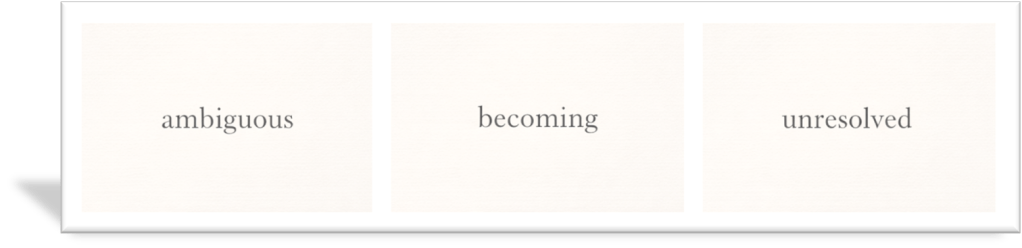
The reflections shared here will return to certain themes again and again. These include social expectations, inherited roles, the performances we are taught to embody, the pressures attached to adulthood, and the boundaries around who we are allowed to be. None of these themes will be approached as fixed or settled. They will remain open, partial, and in motion.
This space exists for those who feel uneasy with boxes, tired of choosing sides, or unsure whether certainty is always the goal. It is an invitation to linger in the in between, and to consider what kinds of resistance might become possible there.
 The Ambiguous Space
Leave a comment